Showing posts with label family heritage. Show all posts

Tuesday, July 12, 2022

WM C HASSELBRINK OF FRANCISCO INDIANA FOUND!

 FRANCISCO MAN GOES MISSING FOR 20 YEARS
-------------
Just walks away from shop, farm and family - DISAPPEARS!
-------------
DISCOVERED DEAD SOME 284 MILES FROM HOME

This crazy story happened in the first three decades of the 20th Century in a rural part of Southwest Indiana where I'm from. I have marital connections to this family from Francisco, Indiana. It's such a small farming hamlet, one time hub of commerce on the Wabash & Erie Canal, that I'm related to most of it's early inhabitants.

Well, the Hasselbrinck family is no exception. The spelling with a "c" seems to have come from the old country. William Carl, the subject of this made-for-TV saga, was the child of German immigrants, born in 1856. He grew up on a farm in rural Gibson County, outside Francisco (or Frisco, as locals call it). In his 50's, he put together stock and capital to open a hardware store in town, circa 1909. It had been in business with the aid of his son George William Hasselbrinck, about four years when the owner walked away.

Reasons are sketchy as to why, but on a Thursday, middle of September 1913, with no advanced warning, William simply walked away...from his home, from his store, from the hamlet of Frisco, Indiana. 

24 Sep 1913 Evansville Courier and Journal, p. 19

Apparently, the day was 18 Sep 1913 and the talk about Oakland City and Princeton and surrounding towns was about this mysterious disappearance of a 56-year-old man. The article, above, ran in the nearby Evansville newspapers almost a week later. A few days after that, it was picked up by a paper in Madison (IN) this time with speculation as to why.

27 Sep 1913 Madison Daily Herald, p. 2

All up and down the Ohio Valley, local Indiana papers were picking up the thread, like this one two weeks post-disappearance, and each sheds some new light. The article, below, from Spencer County, says that the subject was last seen cashing a $17 check at a bank in Princeton. Where he was headed was not known. A family and community grasping for answers assumes the man was "slightly deranged."


3 Oct 1913 Rockport Democrat, p. 3

After 40 days, the Evansville papers run a picture of William with his physical details and announcement of a $25 reward offered by his wife. This would translate in today's currency to about $740. Later, we learn that his description and this reward were circulated nationwide.


1 Nov 1913 Evansville Courier and Press, p. 6


Then, in 1914, an apparent break in the missing persons case! The body of a man is found floating in the Ohio River near Evansville. It has been drowned for some time and is decomposed, but folks say it matches William's description. The community is cautiously hopeful. This article ran on the front page of the Princeton Democrat newspaper:


20 May 1914 Princeton Daily Democrat, p. 1

The following day, the Evansville Journal reported on the body found:


21 May 1914 Evansville Journal, p. 5

Even the small town Poseyville News weighed in on the matter some eight days later. Interesting to note, the piece of evidence heretofore unknown. William was last seen aboard an interurban headed towards Evansville. That could have been the route our wayward wonderer took, but who can be sure?


29 May 1914 Poseyville News, p. 4

After the excitement and buzz over potential closure to this case, reality began settling in upon the family. His estate was settled and in Sep 1918, five years after her husband died, the alleged widow went after his life insurance company, as reported on the front page of the Oakland City paper.


20 Sep 1918 Oakland City Journal, p. 1

I'm sure interest died down in the immediate aftermath of the body found near Evansville years earlier. The family gave up hope of ever hearing from him again and doubted they'd learn the details of his passing. It was as if he'd just vanished from the planet. There was no GPS or Internet, surveillance cameras or cable news. In fact, news in 1913 travelled very slowly at times, especially in rural areas like Gibson County, Indiana. It must have seemed like all hope was lost.

Meanwhile, on the opposite end of Illinois, almost 300 miles away, William was farming in the community of Glasford, keeping a journal and speaking of his faraway home. When the connections were made, he was already laid to rest. His family had given up on ever finding him more than 10 years earlier. He'd been gone for almost 20 full years!


The story hit the newswires and this United Press article ran in the 9 May 1933 Indianapolis Times on p. 4. This must have given the family some modicum of closure, even if the why's and how's could never be answered. William Carl Hasselbrink would be brought home and laid to rest. In fact, he was buried in southern Gibson County, southwest of his Francisco home, at St. Paul's Cemetery along State Road 168.

I found all of these articles yesterday in a search for relatives. It took me on a wild ride down some rabbit holes, but I was transfixed and fascinated by the details--that a man would just walk away from his home, his family, his life of more than half a century and move that far away and just start over, too afraid, perhaps, to contact his wife or to go home. This would make for great television drama. Who has the number for Netflix, Hulu or AppleTV?


Wednesday, June 01, 2016

Alice K. Thurston, Deaf and Determined, my 2nd cousin

This morning, I came to the Thurston branch of my family tree, which shoots off from the Greeks and McCormicks of Gibson County, Indiana. For reference, my third great-grandmother on mother's side was Berilla (Mills) Greek, who lived 1829-1908 and was the daughter of my pioneer ancestor, Duston Mills (1804-1875), and wife of prominent Gibson Co. farmer, Joseph Greek (1822-1911).

Berilla's grand-daughter, Helen McCormick-Thurston (1902-1980), had two daughters--Evelyn in 1925 and Alice in 1931. Helen was a single mother in 1940, raising her daughters alone and running a beauty salon in Princeton, Indiana. The girls were listed on the 1940 U.S. Census as living at home with their mom; however, I found a second census record that year for the youngest one, Alice K. Thurston, and it led me to this:

INDIANA STATE SCHOOL FOR THE DEAF Indianapolis

I searched for records of her attendance, but could find nothing on Google. On the school's website, I found the Admissions Office and contacted a Mrs. Rice. She led me to the digital collection containing their archives on Indiana University's website. That's where I struck gold, including this senior picture of Alice, giving her full name and hometown.


Not only was that such a cool find in and of itself, but her name is the same as my grandmother, Alice Kathryn Dunning-Larson-Wright, just spelled in the "southern Indiana way." In fact, I've seen my own grandmother's name mispelled "Kathern," they way it's pronounced in the country. :)

The school had a monthly publication, first called The Silent Hoosier, but by the time Alice enrolled in January 1937, it was simply called The Hoosier. Not only was Alice in that publication dozens of times between 1937-1950, but she submitted more than a couple of articles, including this one on learning to swim in the May 1949 edition of The Hoosier:

LEARNING HOW TO SWIM
I have been afraid of water all my life and never learned to swim until last summer. My sister and brother-in-law tried their best to make me overcome this fear. When they tried to teach me how to swim, I was very stubborn. They let me go after they helped me to float many times. I was choked, but sure enough, I conquered the fear. I learned to do several things in water. I have not learned to swim skillfully, but it is satisfying to know that I can swim some. Now I would love to go swimming. —Alice Thurston

I learned all kinds of valuable information from that publication, like her nickname "Thirsty," the names of her best friends and her aspirations. During her last two years at the school, she aspired to become "the world's fastest typist," the Vice-President of the United States and the operator of her mother's beauty shop in Princeton. I don't know if any of those aspirations were realized or not, but I feel like I came to know my second cousin a little bit better. She was a very active student at the school, attending there from K-12, participating in clubs, music, cheer squad ("yell leader")--yes, the deaf school had yell leaders--and writing for The Hoosier. She graduated June 6, 1950 and the trail for her grows cold.

Her parents either divorced or her father perished while she was a student at the Indianapolis-based school, about a three hour drive from her hometown. There was one instance where she wrote about a visit by her mom, dad and sister, in the late 1930's. My best guess is that her father left for California, remarried and became an auto mechanic for a Bakersfield, CA, Chevrolet dealership. Her mother reported to the 1940 Census taker that she was widowed. I'm not certain, but I do know that she grew to womanhood without her father's presence. I can't imagine that opportunities were as plentiful in the 1950's for people with disabilities as they are today, but with her good looks, abilities and determination, I'm sure she made a good life for herself.

Discoveries like that are what fuel my drive to complete the book I'm writing about my family, from pioneer times in Gibson County, IN, to the present. Thanks for taking the time to read this post.

Wednesday, April 27, 2016

My Dunnings and the Great Flood of 1937

The Great Flood of 1937 hit the Ohio River Valley hard in mid-late January after 12 days of rain caused every tributary to over top their banks, flooding 70 percent of Louisville and 90 percent of it's sister city, Jeffersonville, Indiana. Things were so bad down river that Evansville officials declared Marshall Law. Upstream, things were nearly as dire for towns like Hazleton, Patoka and Wheeling, Indiana. The highest crest ever recorded in the town of Hazleton, situated at the mouth of Robb's Creek on White River, was in January 1937 at 31.7 feet, just for reference.

Gaylord, Elsie & Nancy Kirk
We'll get back to the flood momentarily, but first let me introduce you to my Aunt Elsie's family. That picture was taken around 1957 of Aunt Elsie with her husband and oldest daughter. Elsie was the first child born to my maternal great-grandparents, David and Ruth (McEllhiney) Dunning. 

She was born in 1909 on the farm of her grandparents, Thomas J. and Rhoda (Greek) McEllhiney. In fact, the attending physician mistakenly wrote her last name as McEllhiney on the birth certificate when, in fact, she was the first Dunning child born in Center Township, Gibson County, Indiana.

Aunt Elsie married Uncle Gaylord on Christmas Eve 1933 in Evansville. She had spent the better part of her life taking care of eight younger siblings, so having kids was not her first priority after marriage. Oldest daughter, Nancy Gayle, wasn't conceived for almost seven years. In the meantime, the young couple took up residence in a house near Hazleton, owned by the Ice family. The Ices were property owners north of Wheeling, not far from where Elsie grew up. The Dunning family farm was on Wheeling Road, north of Francisco. Anyway, Elsie's older cousin, Venita McEllhiney had married Charles Ice three years earlier, so we know the cousins were tight with Charles and his family. While living near Hazleton, Gaylord was a bus driver for the local school there. It wasn't long before they moved into the house owned by Gaylord's grandfather, John A. Kirk, elsewhere in Washington Township, Gibson County.

When they moved to Section 1, Center Township in Gibson County, they were living in the Netty Moore house very near where Elsie attended 7th and 8th grade at the Lawrence School, a single-room country schoolhouse before the consolidation of county schools in 1927. She never went beyond the 8th grade. That old schoolhouse, as well as the Netty Moore place where she was living, was on property once owned by her 3rd great-grandfather, a war hero, Joshua Stapleton, who fought the Native Americans at Tippecanoe (and I believe, also saw battle during the American Revolution). Joshua had lived there as early as 1820 and donated the land for Lawrence School. This was the best place they had lived since getting married in 1933 and it put Elsie much closer, within 2 miles, of her family home.

So that Gaylord could work his own farm, reaping more of his labor, they once again moved within Center Township. This time, they moved even closer to Elsie's family, taking up residence on the 100-acre Morrow farm on Wheeling Road in the Patoka River bottoms. It was late 1936 and they were about to experience one of the worst flooding disasters in Indiana's history. By mid January the next year, with the ground frozen and saturated by the Indiana winter, the rains began to fall, 15 inches in 12 days at Louisville fell from January 13-24th, according to the National Weather Service. As noted at the beginning of this post, it was a disaster of epic proportion for the entire region.

The land rented from Vesper Morrow began to fill with water. Unlike their McEllhiney neighbors across the road who had built their house on an elevated piece of land in the bottoms, the Morrow home that Gaylord and Elsie lived in was at ground level. The Patoka River flowed into the first floor of their farmhouse, but they had prepared by removing valuables to the second level and elevating furniture as best they could. Wheeling Road was impassable below the Dunning farm and the Kirk home on Vesper Morrow's farm was only accessible by boat until waters receded in February. The family had escaped in time and most of their valuables and sentimental items were spared.

It was still a mess and took some time to get back to where they were when they had moved in a few months earlier. Keep in mind, this disaster came on the heels of the Great Depression. As Uncle Les (Elsie's younger brother) reports, the financial crisis did not hit farm families quite as hard as they were more self-sufficient than ordinary homes. For instance, "they had their own wheat for flour, cows for milk and butter, chickens for eggs and meat, hogs and cattle for meat, their gardens for vegetables, enough crops to feed the livestock and sell for the staples needed. Eggs and cream were sold for salt, pepper, coffee, baking powder, soda, sugar and etc." ("The Early Life of Elsie Isabell Dunning/Kirk/McDowell" by Leslie Dunning.).

Elsie took the hardships of the flood without complaining and accepted the gracious help of friends and neighbors to recover, clean and set back up her home. In early 1938, she was dealt another setback, as her mother left her father at home with two children and another finishing high school. Elsie stepped in to help her grieving father take care of the house and the children, stepping back into the role she served as a teenager. 
Aunt Elsie

Her mother left with Elsie's Uncle Edward Williams and soon filed for divorce from David Dunning. This was quite a shocking development and David demanded that his ex-wife, Ruth, have no contact with their children, the youngest of whom, Carl, was only six. Two years later, Elsie became pregnant with Nancy, who was born in early 1941. By then, her brothers, Roy, Tom and Les were serving our country, Ginny was in high school at Francisco and Carl was in 4th grade.

Aunt Elsie survived the Great Flood of 1937 that claimed nearly 400 lives, fairly unscathed, and the personal tragedy at home of her parents' 1938 divorce. She was a great stand-in matriarch for the Dunning family all while trying to start a family of her own. She and Gaylord Kirk had two daughters who are still living in the area where their parents made their humble start. Speaking of humble beginnings, Elsie started her life in a one-room log cabin and grew up on the Dunning homestead, which still stands (in an updated form) on Wheeling Road outside Francisco, IN. She was my great-aunt and lived a great life of 96 years.

My family has now farmed Center Township in Gibson County, IN, for more than 200 years. I'll be posting more about our pioneer ancestors in the weeks to come to commemorate the bicentennial of the State of Indiana, admitted to the Union in 1816.

Thursday, April 14, 2016

My pioneer family and ties to Lewis & Clark

Today's pioneer history lesson takes us back to 1799 and Gibson County's oldest known settler, Keen Field. I was transported back in time when I first saw his grave, marked with a pioneer-era tombstone, a piece of slate with his name rough-etched into it. He's buried north of Patoka, Indiana, in a cemetery now known as Field-Morrison Cemetery, once maintained by my late Uncle Les Dunning. It sits at the edge of a corn field alongside the railroad tracks and CR 50 E. It is the cemetery where my Morrison ancestors from North Carolina are buried.

It is Rachel E. Morrison (1840-1917), my third great aunt, who ties me to the famous pioneer family. I say famous because Keen Field's wife, Anna Lewis, was kin to Meriwether of the famed Lewis and Clark Expedition. Keen's brothers, Joseph and Reuben Field, were part of Lewis & Clark's Corps of Discovery. Anna (Lewis) Field gave Keen at least 10 children, some born in Kentucky before the move in 1799 to Indiana. Their grandson, Joseph Jackson Field (1831-1864), who died in a sorghum mill accident, was my Aunt Rachel's first husband, married in Gibson County 8 Jan 1863.

The Field and Morrison families were part of what became the Steelman Chapel neighborhood just north of Patoka. That area, first surveyed by the British when it was still part of the Northwest Territory, is laid out in 100-acre tracts running diagonally, SW to NE, known as Military Donations (land that was given to American war veterans in the late 18th and early 19th centuries). The Field family owned Military Donation 10, just south across Steelman Chapel Road, from where the pioneer cemetery mentioned above is located. The Morrisons took up farming just east of there and on the north side of Steelman Chapel Rd, sometime during the last half of the 1850's.

Aunt Rachel was married twice. After her first husband's accident, she married a Henry Barton, whose lineage I have not confirmed, as there were at least 3 Henry Barton's born around that time in Knox and Gibson counties. The headstone where he is buried at Shiloh Cemetery, not far from the original family farm, bears a birth date nine years later than his actual birth--a mistake on the part of the family or the gravestone engraver, I'll never know. I only have record of one child, Nancy Jane Field, being born of Rachel's first union. However, with Henry, she bore at least six children. She died 5 Dec 1917, at age 77, near Patoka and is buried near her parents, David and Jane (Swaim) Morrison, in the same cemetery as Keen Field.

Though not a direct relative, I took much time in researching the Field family from Virginia, who settled at the mouth of the Salt River, just south and west of Louisville, KY. I happened upon Lucie and Gene Field's research some years ago at luciefield.net, where they have painstakingly laid out the family history and retraced the famed steps of Meriwether Lewis and his intrepid group of explorers. It was with great sadness that I did not get to meet Gene and Lucie in person during their trip to SW Indiana in the Summer of 2011. Gene Field left this world two years later, leaving a great legacy to those of us who were connected to his family, either by birth, marriage or friendship.

I've been painstakingly tracing my roots back to the pioneers of Knox and Gibson counties for the better part of 15 years. My mom's lineage goes back to pre-Indiana statehood and pioneers from Maine by the English name, Mills. Since this is the state's bicentennial, admitted to the Union in 1816, I'm near the end of writing a book about that family, showing where we've come in 200 years, it's working title is "My Mills Family: 200 Years in Indiana." Stay tuned for more as I travel along in this quest.

Monday, November 14, 2011

A Hero Remembered

Grave of Clifford O. Carlton
1924-1991
(Garden Sanctuary Cemetery, Seminole, FL)

On the heels of Veteran's Day Weekend, I thought it appropriate to honor the memory of one of my ancestors. His name is Clifford O. Carlton, of Evansville, who served heroically in the U.S. Air Force/Army during World War II.

I was researching Clifford's family, as I am a 4th cousin,* and ran across these newsclippings in the Browning Genealogy database (http://browning.evcpl.lib.in.us/):

4 Jan 1945 -- "Pfc Clifford O. Carlton was wounded in action in Germany on Dec 16 [1944]. An infantryman, he also has served in England and France since arriving overseas in August, 1944...A former Reitz High School student..."

24 Sep 1945 -- "Pfc Clifford Carlton, brother of Mrs. Heal, is now home on sick leave from Fletcher General Hospital, Cambridge [Ohio]. He is recovering from left leg wounds suffered last Dec. 16 in battle east of Cologne. In the Army since April 3, 1943, he trained at Ft. McClellan, Ala., Ft. Benning, Ga., Ft. Mackall, NC., and Camp Forrest, Tenn. When injured in a parachute accident, he was transferred to the infantry. Going overseas in July, 1944, he served with the 8th Division. His decorations include the Purple Heart, good conduct and American Defense ribbons, a three-star-studded ETO ribbon and combat infantry badge."

Clifford and his wife, Jane, retired to Madeira Beach, Florida. He died 25 Feb 1991 at Bay Vines Veterans Hospital in St. Petersburg. He was laid to rest at Garden Sanctuary Cemetery in nearby Seminole, FL.

* Clifford and I are 4th cousins, 2 times removed, because his second great-grandfather, Bracket Mills, was a brother to my fourth great-grandfather, Duston Mills, of Gibson County, Indiana.

Friday, September 24, 2010

My Dunning Discovery

Next weekend would've been my great-grandfather's 126th birthday, so to celebrate we'll make our annual excursion to the tiny hamlet of Francisco, Indiana, to visit with several generations of David Dunning's descendants. Though he passed in 1977, at the ripe old age of 93, we continue the tradition started by his family decades ago. We still meet at his farm on Wheeling Road that holds so much in the way of memories, including how he fed and raised nine kids there. Only two of his children will be able to share in the festivities October 2-3, my Uncle Les (88) and Aunt Ginny (85). Yes, they are great-aunt and uncle, but we've always called them by the moniker Mom used to address them growing up.

It is fitting that my latest genealogical discovery involves Les and Ginny's grandparents, my 2nd great-grandparents, Albert Charles "AC" and Sophronia (Morrison) Dunning. Since they died in 1932 and 35, respectively, all I had were bits and pieces of family stories and folklore. I only found some old pictures of them while going through my late grandmother's things a couple of years ago. Here is one of the family taken about 1884.

That's my Great-Grandpa David sitting in his father's lap. The two older boys, George and Robert Charles, died when they were 25 and 13, respectively, so I never knew them either. Aunt Bessie is seated in Sophronia's lap.

Needless to say, I had no clue where they lived other than the old census records that gave their residence as White River Township in Gibson County, Indiana. Well, lo and behold, the 1881 Atlas of Gibson and Pike Counties shows the location of the old family home in the White River bottoms. I had studied that map several times at the library and online before I discovered the AC Dunning farm about midway between Patoka and Hazleton and west of the highway about 2 miles. It was sitting right there under my nose!

So on my last visit to the area (just last week), I was able to get access to the old property in the river bottoms from the current owner. Unfortunately, the Dunning home is gone, bulldozed by the current owner five years ago. But I walked where my ancestors once lived, along an old creek and down a steep, sandy, one-lane road eroded into the side of a hill. Driving down that narrow lane was like stepping back in time. I could imagine the horse-drawn carriage or wagon bumping down the sandy slope, through a corn field, around an old barn and to their two-story, white, wood-framed farmhouse. They raised their children in that home, along with some chickens and livestock. The current landowner says he knocked down an outhouse and chicken coup in addition to the old house. He walked the property with me, pointing out the location of everything. In fact, if you look on Google Earth, you can still see the footprint of the house.

I look forward to seeing the family this weekend and hearing more old stories of David Dunning and his parents who survived floods and the hard life of late 19th-century farming. I can't wait to ask Uncle Les and Aunt Ginny if they have any memories of the old home in the river bottoms. All I have is a picture taken beside the house in the teens or 1920's. AC and Sophronia are elderly, their children all grown, at least David and his three surviving sisters (three brothers died, the two mentioned above and one as an infant). As I said, it was a hard way to live back in the late 1800's in rural, southwestern Indiana.

We'll gather at the spot where my great-grandfather celebrated his 93rd birthday nearly 34 years ago. He is buried at Fairview Cemetery just one mile west of his home (pictured above about 1993). I remember attending his funeral as a 9-year-old boy. It was a tragic year for me, as I lost my Grandma and Grandpa Doyle in March '77. Still, the reunion brings back great childhood memories, not just of Grandpa Dunning, but of the whole family gathering to tell stories, play games and, yes, eat our fair share of down-home goodness! We'll be doing it again in a matter of days, and I cannot wait!

Wednesday, September 01, 2010

James Hussey Letter dated 12 Sep 1862

I've been building my family tree online for the better part of 8 years, but only recently purchased access to the vault of records on Ancestry.com. Today, I made one of the coolest finds to date. First, let me give you a bit of family history...

Back when Indiana Territory was a vast wilderness of tall timber, unspoiled watersheds and every kind of wild beast, my pioneer ancestors came from all points south and east to settle this veritable, backwoods paradise. Of the New England-born pioneers, was the family of Richard and Aphia (Mills) Hussey.

According to Gibson County newspaper man and historian Gil R. Stormont, the couple and their 4 children left Maine and travelled overland through the Genessee Valley (NY) to Washington
County, Ohio. Richard Louis Hussey (1789-1851) was a cabinet maker there for four years. Aphia bore him two more children before they left in late 1821 for Gibson County, Indiana, locating 5 miles east of Princeton, near Francisco. There, Richard cleared a farm and opened a blacksmith shop. He is my 5th great-uncle on Mom's side.

The last of the four children to be born in New England was James Madison Hussey (1817-1862). He would have made the long overland trip as an infant, knowing only thick woodlands of southwestern Indiana as home. After many years service to his father, clearing and cultivating a farm, James owned and operated a flour and a saw mill on the Patoka River in nearby Kirksville (now Wheeling), Indiana. That was before he heard the call of duty to put down the rebellion. James enlisted in the Union Army on August 2, 1862, and served as First Lieutenant in Company B, 65th Regiment, Indiana Volunteers.

It wasn't long before 1st Lt. Hussey contracted a serious illness and found himself bedridden at Camp Comeback in Henderson, Kentucky, southward across the Ohio River from Evansville. It is at this juncture we come to the present moment and my great find. Thanks to another Ancestry member, some of J. M. Hussey's correspondence has been saved in digital format for antiquity. Below is a scanned image of the opening of one of his last letters to his wife, Sarah, dated (on my birthday, no less) September 12, 1862. (Click on the image for a more readable, full-size version.)


By early November of that same year, James Madison Hussey was dead. He never recovered from his illness, as historian James T. Tartt recalls, James died of pneumonia in a Henderson, Kentucky, hospital. He received a military burial on the family farm back in Indiana. Now owned by the McConnell family, Lawrence Cemetery sits at the corner of a field just off Fairview Road near Francisco.


Thursday, July 15, 2010

Pancakes & Smoky Links

There was a Sunday morning tradition at Grandma Wright’s house. After attending worship service at the Methodist Church on West Emmerson, she would make a stack of pancakes on the stovetop griddle and boil Smoky Links in water (or “boral” them, as she would say in her southern Indiana twang). That is a fond childhood memory for me, and I don’t recall one Sunday that she didn’t keep up this tradition.

Alice Kathryn Dunning, my maternal grandmother, was my dearest grandparent. She was born on the farm in Francisco, Indiana, in July 1920. She came from humble beginnings, helping to raise chickens and her siblings on her father’s farm on Wheeling Road. The sixth of nine children born to David and Ruth (McEllhiney) Dunning, she was only 17 when her mother left home. Taking on more responsibility at the farm, Kate learned to be self-sufficient and hard-working. These are traits that I remember well.

Married in 1937, the same year of her parents’ divorce, Grandma started a family of her own with Richard Larson, a second generation Swedish-American. They lived in a modest home just south of Highway 64 in Francisco and had three children, my mother being the youngest and only daughter. Richard was a hardworking, entrepreneurial type who needed nothing more than his hands and a working truck. They enjoyed life as a lower-middle class family in a small farming town until Grandpa Larson’s injury kept him from manual labor. This caused him to sink into a depression he couldn’t shake. As a result, he was hospitalized in Evansville and eventually granted my grandmother a divorce in 1961.

Grandma met a World War II Veteran and jeweler around that same time. Kathryn Larson and Robert Edgar Wright married October 1962 and within a year-and-a-half had a son, Gregory. He is the one pictured holding me as an infant.


Grandma Wright, as I always knew her, held a job at Hurst Corporation and made a decent living. Grandpa’s jewelry business was located on Main Street in Vincennes, and between the two of them, they made a very good living. Their house was situated atop the hill in Tower Heights just two doors south of Gibson General Hospital, where I was born in ’68. I can remember many summers and holidays at Grandma’s house on Third Avenue. When I was an adolescent, my parents would let me spend a week at her house. Those are some of my fondest childhood memories. Having an uncle around, just four years my senior, ensured that I would have plenty to do while I was there, whether playing his drums, taping his album collection, playing ball in the backyard or riding his moped all over Princeton’s north side.

While at Grandma’s house, I also enjoyed running errands with her—out to Grandpa Dunning’s farm to pick vegetables, down to the Red & White or 3-D on Broadway, over to the veterinarian to meet Aunt Elsie for lunch or to the beauty parlor for her bi-monthly hair appointment. A rather funny memory is Grandma’s rain bonnet. She would protect her hairdo from the elements with a plastic rain bonnet; you know the kind only grandmother’s wear in public. Well, she would fuss over me getting wet and insisted that I wear one, as well. I always refused, but the mental image still gives me a chuckle.

Grandma was diagnosed with breast cancer after my family had moved hundreds of miles away to Florida. I didn’t get to see much of her after 1986, much to my disappointment. I was living in Tallahassee when she finally died in February 1990. That is one of the saddest days that I can remember. I was able to return for her funeral at Colvin and her burial with family at Fairview Cemetery, near Francisco. My Uncle David, her oldest son, now lives across the street from where she rests.


Grandma was such a great cook and I recall the many pies, cobblers, cookies, biscuits and pieces of fried chicken she would lovingly make…but my favorite meal was Sunday breakfast. As I sat at the kitchen table this morning, enjoying hot pancakes smothered in peanut butter and syrup (a family tradition) and Smoky Links, I remembered Grandma Wright. The smell, the taste, the week of the year, all brought back vivid memories.

She would have turned 90 on Tuesday. And though she died much too soon, I have many reminders of her, not the least of which is my daughter who bears her name and nearly shares the same birthday, just two days shy. I really do miss Grandma Wright, may she rest in peace.

Wednesday, November 18, 2009

Decker Township (Knox Co) Connections


The excerpt above is from The History of Knox and Daviess counties, Indiana (The Goodspeed Publishing Co, 1886). I found it while researching my ancestry in Knox and Gibson counties. I am descended from the early pioneers of southern Knox and northern Gibson. Three of the families mentioned, above--Decker, Anthis and Jacobus--all have links to my family tree. However, I don't have much information on these families other than what has been captured in this 1886 publication.
The old land plat maps in the IUPUI Digital Collection show adjoining farms along the White River in Decker Township that belonged to my family--the Morrisons--and to the Decker and Anthis families.
Ond of my connections to the Anthis family traces all the way back to Jacob Anthis who settled in Knox County from Tennessee, possibly before the turn of the 19th century. His great-grandaughter, Clarissa A. Field, married my second great-uncle Fletcher A. Morrison in 1880. Clarissa was a member of the Field family, who were also Gibson County pioneers. There is an extensive website of the Field family at www.luciefield.net.
If you know a Decker, Anthis or Jacobus from Indiana, won't you put them in touch with me?

Monday, August 31, 2009

70 Years Ago Today, WWII and my family


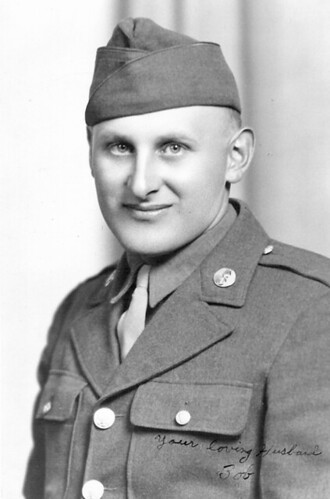
Above are pictures of my grandfathers Doyle and Wright from the 1940s. They served the United States valiantly, as did all the brave men and women of "America's Greatest Generation." Today, on the 70th anniversary of World War II, I honor their memory and that of every soldier who served to secure liberty and promote the ideals of democratic society.

In addition to my grandfathers, several great uncles also served the U.S. Military in both theatres of the war. Fortunately, they all made it home to Indiana and rejoined their families. One of them, my Uncle Les Dunning, is a decorated veteran and still lives today in Dayton, Ohio.

Thousands of families were not so lucky. None were as unfortunate as our Jewish brothers and sisters across the globe, especially in Europe. Think for a moment of the many generations of families that were cut off due to the fanatical, genocidal policies of Hitler, Himmler and the Third Reich. I was watching a documentary recently in which the son of a Holocaust survivor was mourning the loss of his grandparents. He wasn't fortunate enough to ever know them.

And while my father's father (pictured above left) died before my ninth birthday, I at least got the chance to spend time with him and love him in the flesh. He and his brother returned to father children. My mother's uncles all returned to start or rejoin families. I still see some of those first cousins, once and twice removed, at family reunions. This year, as I reflect on what happened two generations ago, I will cherish those members of my family even more, knowing now just how fortunate I really am.

See WWII anniversary news articles here.

Monday, July 21, 2008

Roots

Genealogic research performed by uncles on both sides of my family has piqued my interest in our families’ history. They’ve dug diligently to trace our European ancestry as far back as the 17th century. You can view much of our lineage if you click the Geni link to the right.

My interest in history swings much broader than just my own family tree, however. I’ve recently begun investigating the history of Lyles Station and that settlement’s connection to the Underground Railroad (UGRR) in Indiana. My aim is to establish a solid link between the African-American community in Gibson County and the white abolitionists who aided them, like the Stormont family, and thereby obtain an Indiana Freedom Trails marker as a monument to their efforts.

I guess a combination of these interests caused me to checkout the 30th Anniversary DVD of Roots at the local library. That, and my wife was not allowed to watch it as a child, so this was her first viewing.

I was surprised how little of it I remembered even though it made an indelible impression on me when I first saw it on television in 1977. And while it only gives small glimpses into the UGRR, it continues to stir my curiosity about the secret pathways north and the courage of those who dared to travel it and also those who risked all to aid the escapees.

It stands to reason that free African-Americans in the “lower north,” particularly the settlements in southern Indiana, would have been a first stop along the pathways to freedom. Some escaped slaves would have surely settled there while many others would have continued north to Michigan and Canada.

The problem in documenting all this is that most of the 19th century American history you find in libraries was written by white men. They weren’t particularly interested in elevating the heroes of the African-American community. Their self-serving portraits of abolitionist activity paint an almost white portrait of the UGRR, as if no escape from slavery would have been possible without the aid of anti-slavery whites. While this may be true in part, it is not the whole truth.

Have you ever considered what it would have been like to be a slave on the run and scared for your life? Who would you trust? It certainly wouldn’t be a white man. So my work is definitely cut out for me. This will not be an easy project to document with concrete evidence. Just like my uncles, I will have to dig to uncover the important role the free African-Americans of Lyles Station played in helping others to freedom.